
4/13/11


9/28/10
FILIPINO FOOD
ADOBO: THE RECIPE

In a medium sized bowl add equal parts of cider vinegar, soy sauce, and water. I use 1 cup of each. Adjust amounts to your desired taste. You should be able to clearly taste equal amounts of both the vinegar and the soy sauce. I like to make a lot of the liquid mixture, because I love to pour it over my rice. Mix in 2-4 (or more) Tablespoons of paprika. The paprika will give good color to the adobo and round, [or mellow] out the intensity of the vinegar and soy. In a large heavy pot or skillet brown meat of choice. If using chicken season with salt and pepper and brown, starting with the skin side down. I usually use 8-12 thighs. Figure 2-3 thighs per person. Brown on all sides and set aside. If using pork I like to use a shoulder roast. Cut pork into 1" cubes season with salt and pepper and brown well on all sides. I usually consider 3-5 oz. of boneless meat per person. Set aside. In a large stock pot add a little fat and slowly cook an entire head of chopped garlic over mediun heat. Add the browned meat to the pot and pour the vinegar mixture over the meat. Add a small hand full of freshly cracked black peppercorns. Cover and simmer until meat is tender. Skim off any excess fat and serve with white rice. Adobo, if there is any left, is even better the next day.
 This is something that everyone in my entire family makes. Imagine all those slightly unique nuances in my family alone! Aside from scrambled eggs it seems that you are christened an official cook in my family once you first make adobo. There are "out-to-jury" debates still up in the air whether you should add pickling spice or not. Truthfully, sometimes I add it and sometimes I don't.

Adobo is traditionally served over or with rice. The ingredient list is simple. All of the ingredients are staples that almost everyone has in their pantry. This is a dish that can be made quick or slow. That is one of the great things about it! I have made this tangy soupy Filipino dish for many of my friends over the years and like my mothers chili the initial reaction in always something to behold!

First of all, there is an amazing combination of smells when you walk into a house where adobo is being made. Because one of the main ingredients is cider vinegar. One can not help becoming overloaded by the pungent aroma of vinegar. Along with the aromas of garlic and soy sauce it simply is a symphony to your sense of smell.

The spices are simple as well. Salt, freshly cracked black peppercorns, garlic and paprika are all you need to make this wonderful dish. At first taste most people are overwhelmed by the sharp flavors, but after the flavors start to roll around the palate, the complexity starts to reveal its unusual composition.

Adobo can be made with chicken. It is probably the most popular. Any and all parts of the bird can be used. I prefer using thighs, because I am a huge fan of the dark meat of chicken. For me, the breast has a tendency to become a little too dry, and legs are just too much work. Over time I suggest that you try all different cuts of the bird to find-out what you like best.

Pork is the other meat of choice to use for adobo. If you are a true Filipino than you know that beef is never used to make adobo. My grandpa use to make it in his restaurant, but it is unusual. It is good and you can be done, but like I said, "you just don't do it!" I think that the reason for not doing it is because the vinegar has a tendency to really dry-out the meat.
POTLUCK with Michael Patrick McKinley
DOUBLE HAPPINESS MEATLOAF
I've never been a kethcup on meatloaf kinda guy...

When Stacey told me he was planning to "skew Asian" for the October edition of The Dish, I scratched my head for just about a minute. I've been having a life-long affair with Asian cuisine, but a signature dish of my own to share with you? I didn't think I had one.Then I remembered my meatloaf. This is a recipe that's been evolving over time, but started as a simple turkey meatloaf about 15 years ago. You know, the kind with Lipton's Onion Soup Mix . Only one night on it's way into the oven, I realized I had no BBQ sauce to glaze the top of it with, and I don't do ketchup with meatloaf. Meat pies however, are another story! I digress...
I foraged through the fridge to see what I could substitute for that sweet-salty, caramelizing factor I'd be missing without the BBQ sauce. Then suddenly, there it was. Like a cartoon style light bulb moment, the jar of Hoisin sauce imprisoned in the door compartment beckoned to me to set it free, and slather it across my ordinary turkey loaf. The result was sensational, and I haven't seen Sweet Baby Ray since!
Of course you can bake this in a loaf pan, but why? When you plate these little lovelies, streak each plate with additional hoisin sauce, then place 2 on each plate [one sitting on its butt, the other playfully tilted on it's side], and sprinkle with some chopped cilantro leaves. To me, meatloaf is a very Autumnal meal, so I love to serve it with baked hard squash that's on the naturally sweet side, like Buttercup or Hubbard, and finish the meal with roasted Brussel sprouts.
Make these for your next dinner party, and your guests will not only be impressed by this Asian inspired twist on an American comfort food classic, but your clever presentation too!
1 1/2 lbs Ground Turkey
1 1/2 lbs Ground Pork
2 eggs
1 tablespoon fat
1 small sweet potato, very finely chopped
1 tablespoon seeded and minced jalapeno
2 tablespoon minced dried onion
2 teaspoons Chinese five spice
2 teaspoons soy sauce
1 tablespoon chili garlic paste
6 scallions sliced very thin
1/2 cup minced water chestnuts
1 1/2 cups panko flakes
hoisin sauce
Preheat oven to 375
Saute minced jalapeno and sweet potato in melted fat [I like to use butter or bacon fat] just until the potato starts to soften. Meanwhile, place all other ingredients in a large mixing bowl (except hoisin). Add sauteed potatoes and jalapenos, and mix with hands until all elements are fully incorporated. Pack mixture into the compartments of a 12-count muffin tin, mounding up over the top of the fill line. [The "meatloaves" will shrink as they cook, and release fats and juices.] Liberally smear the crowns with hoisin sauce, and bake for approximately 30 minutes. They should shrink away from the sides of the pan and the tops should caramelize.
Let them rest for 5 minutes, run a knife around the edges to ensure easy release, and remove from tins.

THE ESSENTIAL ASIAN SAUCES
OYSTER SAUCE

Oyster sauce is a flavorful, savory sauce which is Chinese in origin. As the name implies, oyster sauce is traditionally made with oysters, although it is also possible to find vegetarian versions. There are a number of ways to use this tangy sauce, making it a useful addition to one's Asian sauce cupboard.
In addition to being used extensively in China, oyster sauce is also consumed in Thailand and the Philippines, and each nation has developed its own unique take on the sauce. All versions of the sauce owe their origins to ancient Asian sauces made with bases of fermented fish. These sauces all share the trait of being extremely savory as a result of high concentrations of free glutamates, which create a flavor known as “umami” in Asian cuisine.
Credit for the invention of oyster sauce is usually given to the Lee Kum Kee company, a venerable maker of sauces based in Hong Kong. The traditional sauce is made by cooking oysters over low heat for a long time, essentially creating a condensed oyster flavor. As the shellfish cook, the juices start to thicken and caramelize, yielding a very rich, dark, somewhat sweet sauce.
Modern oyster sauce often cuts a few corners, cooking oysters for a brief period of time in brine and then adding soy sauce and caramelized sugar to achieve the desired color and hint at the taste of umami from the oysters. Cornstarch may be added to the sauce to thicken it, and some companies also add monosodium glutamate to enhance the umami flavor of the sauce.
Vegetarians don't have to be left out of the oyster sauce world. A very good vegetarian imitation is made with mushrooms, often oyster mushrooms, in fact, because they have a rich, meaty flavor which reminds many people of the seafood they are named for. Vegetarian versions are often more heavily adulterated with additives to achieve the desired flavor, although some more natural versions are available from companies which specialize in natural vegetarian food.
FISH SAUCE

Fish sauce is a condiment made from fish. There are a number of different types of fish sauce around the world, made in a range of ways from an assortment of species. The condiment is most closely associated with Asian cuisine, since a number of Asian nations use fish sauce extensively. It also appears in the West, however, and the food has a very long history dating back thousands of years.
The base of fish sauce is, naturally, fish. Some producers use salt-cured fish, while others use fresh fish, dried fish, or cooked fish. Anchovies are a common choice, but other species may be used as well, and some fish sauces actually call only for the entrails of the fish, while others use whole fish. The fish is packed in barrels with or without an assortment of spices, and salt is added as well. Then, the fish is allowed to ferment, resulting in a pale brown liquid which smells quite intense and imparts a rich, salty flavor to the dishes it is added to. I advise you to use this sauce sparingly until you get used to the intensity of the particular sauce you chose to buy.
The roots of fish sauce in Asia are ancient, and the condiment has wormed its way into pride of place on the condiment shelf in many countries. Fish sauce may be called nuoc mam, nam pla, patis, or bagoong monamon, depending on the nation. Asian cuisine also includes a family of fermented fish pastes and seasonings which are all related to fish sauce. Fish sauce may be added to dipping sauces, included in the seasoning for stir fries, and sprinkled into dressings for salads and meats. Depending on the nation, fish sauce may be used almost like flavored salt or soy sauce, since the combination of salt and fermented fish packs quite a flavor.
In the West, fish sauce has been manufactured for thousands of years, although it has evolved slightly away from truly fermented fish. The first fish sauce was garum, a seasoning made by the Romans from anchovies and an assortment of other caught fishes. Garum was a crucial ingredient in Roman cooking, and it was carried all over the Roman empire. A modern descendant of garum is Worcestershire sauce, a popular British condiment.
SOY SAUCE

Many of us would not consider having Chinese or Japanese food without using a little soy sauce. But do you know what is in this wonderful sauce, or how it first came to be developed? Here are some things about soy sauce that you may find interesting.
Also known as soya sauce, the exact origins of soy sauce are long lost to history. However, there is evidence that the basic mixture of soybeans, roasted grain, water, and salt has been in use for at over two thousand years. The earliest recorded recipes for making soy sauce are associated with China, although there are variations of this great fermented sauce found in all sorts of Asian cuisine. There is also some evidence that Buddhist monks first brought the concept of soy sauce to Japan during the 7th century, where the innovative Japanese set about putting their own mark on the manufacturing of soy sauce. In fact, there are those that say the fermentation process that developed in Japan produces the finest soy sauce in the world.
Strictly speaking, there is no one definitive recipe for making soy sauce. Of course all of them involve the use of soybeans, and there are one or two that also use soy flour in the recipe. All told, you can find over twenty types of soy sauce to grace your table and enhance the taste of your food. Some of these nationally developed sauces are considered to be fresh soy sauce, in that the sauce is thinner and is made employing a double fermentation process. Varieties that fall into this category are often used for seasoning meats and at the table with vegetables and rice, as they provide quite a lot of taste.
Dark soy sauces are somewhat thicker and usually employ a single fermentation process. The difference is that the dark sauce is allowed to ferment for a longer period of time. Molasses is also an ingredient in the darker sauces, which helps to give them a sweeter taste and less of the salty zing that one finds with the fresh sauces. These types of soy sauce are used in cooking, both for the mixture of flavors and also because they can add color to just about any dish. Dark soy sauce usually is not found on the table, as it is not considered suitable for dipping.
As well as shining on its own and adding flavor to meats and vegetables, soy sauce also takes a bow as a main ingredient in other condiments. As an example, there are a number of salad dressings that employ soy sauce, especially ones that are meant to take the place of high fat salad dressings. Many people are surprised to learn that soy sauce is also a key ingredient in another favorite household item, good old fashioned Worcestershire sauce. Along with being a favorite ingredient in a number of condiments, there are some interesting alcoholic drinks that call for a dash of soy sauce to add a little more zest to the drink. Try some in a bloody Mary!
TAMARI

Tamari soy sauce is a type of shoyu, the Japanese word for “soy sauce.” The technique for making tamari is quite distinctive, yielding a complex, rich flavor which some people find very enjoyable. Many Asian markets stock tamari, and it can also be found at general stores which stock Asian ingredients. True tamari has a very dark color and an almost smoky flavor, and it can be used as a dip, marinade, or baste; it is also used as a component in other sauces and dips.
Tamari is made by collecting the liquid which drains from miso as it ages. Miso is a fermented soybean paste which is a major component in Japanese cooking; miso appears in soups, stocks, sauces, and a wide variety of other foods. It is also made with a range of grains, yielding an array of textures, flavors, and feels. In Japan, tamari soy sauce production is focused in the Chubu region, where it is also known as miso-damari.
In the West, there is a great deal of confusion surrounding tamari. This is because Japanese shoyus were originally introduced, marketed, and sold in the West as “tamari,” rather than being differentiated by type. As a result, a wide range of products were known by the “tamari” name when true tamari soy sauce was introduced. This has been especially problematic for the gluten intolerant, as tamari is naturally gluten free, but shoyu is not, since shoyu is traditionally fermented with wheat.
In fact, tamari soy sauce is distinct from other types of shoyu and soy sauces from other regions, and it cannot be interchanged with sauces like usukuchi shoyu or Indonesian kecap. Tamari is rich with a tangy flavor from the miso fermentation process, and it is one of the darkest forms of Japanese shoyu. Because there is a bit of confusion about shoyu labeling in the United States, people with gluten intolerance should read labels on tamari soy sauce carefully to ensure that it is true tamari, fermented without any gluten.
CURRY PASTE

Curry paste is a finely ground or pureed blend of aromatic spices, herbs, and vegetables. It is widely used as an ingredient in the cuisines of many cultures to make curries, stews, and other dishes. There are many different types of curry pastes, and each country’s blend has a distinct flavor.
The term “curry” comes from the Tamil word for “gravy” or “sauce” and is, therefore, open to broad interpretation. There are two basic categories: dry and wet. Dry curry dishes may be made with whole or powdered spices; wet curry dishes are typically made with curry paste.
The base for a curry paste usually contains ingredients such as ginger, garlic, and onion. Some blends include chili peppers, lemongrass, and leafy herbs. Liquids such as coconut milk, citrus juice, and vinegar may also be used. Nuts and legumes are sometimes added for texture and flavor along with condiments such as Asian fish sauce, shrimp paste, and tamarind paste.
The most common spices are cumin, coriander, and turmeric. Other spices may include dried chilies, cinnamon, and black pepper. Seeds such as fennel, mustard, or fenugreek may also be used. For some blends, whole spices may be roasted before grinding.
Curry pastes are traditionally blended with a mortar and pestle. This method is still used in many cultures, especially in developing nations where electricity and modern appliances are unavailable. In modern kitchens, the ingredients may be pureed in a blender or food processor.
Indian cuisine is best known for the use of curry paste in its many regional dishes. Neighboring countries Pakistan, Bangladesh, and Sri Lanka use similar blends in their cuisines. To the north, Nepalese, Bhutanese, and Tibetan cuisines include their own versions of curry paste.
The cuisine of Thailand features three basic types of curry paste: yellow, green, and red. Yellow Thai curry paste is spiced with turmeric, which turns it a deep shade of ochre. The green type gets its color from cilantro and green chilies. The red blend is made with fiery red chili peppers.

Characterized by a sweet taste and a low alcohol content, mirin is a popular Japanese cooking wine. While use in cooking is far and away the most common application of mirin, the wine is sometimes employed as a ceremonial drink at the beginning of the new year and a few other special occasions. The main benefit of mirin is the dash of sweetness that the alcohol provides for a number of dishes and sauces that are common to Japanese cuisine. In appearance, mirin has a golden hue that is very pleasing to the eye. In addition, the inclusion of this sweet cooking wine will also provide slight sheen when used to prepare fish and various types of meat. Using mirin as an ingredient for coating or covering with a sauce helps to enhance the presentation of the dish, helping the food to be as visually appealing as it is flavorful.
The creation of mirin begins with the use of glutinous rice that is combined with distilled spirits. Manufacturers of this rice wine only allow the fermentation process to go so far, since the focus is on achieving the correct level of sweetness and not necessarily a given level of alcohol content. It is the sweet property of the wine that helps to lessen the overall impact of strong fish odors in a number of recipes, while still managing to enhance the flavors of other ingredients in the recipe.
While mirin does not have a high alcohol content, it is often found in the liquor department of supermarkets, as well as in wine and spirits shops. This is true even for the two ceremonial versions of mirin that are used to celebrate the new year, hon and shin. Because the sweet taste is very strong, a small amount of mirin in a recipe will produce excellent results.
OCTOBER LETTER FROM THE EDITOR'S DESK [ME]
Early Fall
It seems to me that Halloween is more of an actual Holiday here in the mid-west than it ever was in my home state of California. With the exception of my living in West Hollywood, in my adulthood, I have yet to experience anything like the likes of Halloween in the flamboyant Southern California community I called home for many years. Billed as one of the largest spectacles in Los Angeles, Halloween on Santa Monica Boulevard can garner over 200,000 spectators. As a resident and a flamboyant one myself, I have participated in many of those celebrations. Although many of the observers were there to merely gawk at the myriad of freaks donned in feathers and sequins, we as the “Parade of Freaks” roamed freely upon our home streets with pride. One year, when I lived on Norton Avenue with my BFF Michael, one block off of the boulevard, and we were not quite sure what we were gonna do. As a matter of fact, I believe we had originally decided to do nothing, [until the last minute,] that year. I think we were just gonna hit the boulevard for a while, have a drink or two at on of our spots, and then call it a night.
When I got home from work I walked into my house to see James and Michael in a sea of shopping bags and black tulle. For a split moment I wondered what the hell they were doing! Then, Michael walked into his bedroom and came out with this glorious long red curly wig. Giggling and giggling he said, “Isn't it great! Me and James went wig shopping on Hollywood Boulevard!” Truth of the matter was... it was beyond great! It was the most fabulous curly red wigs ever! So, there it was. We were going to become part of it! However, I had nothing because I hadn't planned on going out, [in costume!] so James and I got in the car and rushed down a few blocks to Melrose. I had worked on Melrose Avenue at the La Cienega Flower Shop on the corner of Crescent Heights as well as at Vous, a hair salon, next to Fairfax High School for years and was very familiar with all of the great shops and fantastic boutiques. There is a reason it is one of the greatest shopping meccas in all of Los Angeles. I was not sure what I wanted to do or what I was looking for See, when you live in West Hollywood, and you are doing Halloween you need to be doing Halloween. Usually you would have been working on your costume for many weeks, if not several months. This is very serious stuff in a very serious way!
James and I were walking and talking in the everyday happenings of a neighborhood we were both very familiar with. After stopping in the salon for me to grab a few supplies we headed into the bustle of the world famous Melrose Avenue. We walked into a place where strippers by themed costuming and acrylic high-heeled shoes. Nothing! Can you believe it... nothing. Hummm, I was sure I was I was gonna find something, anything! Truth of the matter was: Halloween costume goers had long since wiped the store clean of anything I was brave enough to wear. What ever! We went to the car, [ EDIT! EDIT! EDIT!] and AFTER A HEAD CHANGE, we walked into a little boutique because there was this dress in the window that I had to get a closer look at.
The garment was beautiful and extremely hand-crafted. I have always been fascinated by well made garments for men or for women. I like to study them, observe the way they are constructed, and feel the hand of the fabric - as this was the case. James mentions that time is a wasting, and as we were walking out the door, I spotted it! On a form high up on the wall – the perfect little black “Mariah Carey” dress! It was a simple black cotton tank dress with just the right amount of spandex. Aside from the white tassel fringe on the neck line it was perfect!
We rushed home to find that Michael was in the process of transforming himself into “Ginger Holiday” It was on! It was almost like you could smell the testosterone fading into a frantic sea of estrogen. Turning James into Mona D was something I had done many times over the years – I could paint his face in less than 15 minutes flat! I was gonna be a different story, because I wasn't big on tights or pantyhose I contemplated shaving my legs. In the shower I heard the guys telling me to man up and shave my legs. So, I did! Remember I had some pretty long hair back then, and no boy ever does his own hair in West Hollywood! With my hair up in a towel I found that James was in the living room already half way to becoming Mona D! I sat James down in a chair, ratted the crap out of his hair, sprayed the B-Geezus out of it, and painted his mug! Viola! James is Mona in fifteen minutes flat!
I take a seam ripper to the ridicules white tassel fringe, slip on the dress, and put on my old reliable black pumps! With the towel still on my head, I powdered my face, applied a generous layer or two of clear mascara, a lined my perfectly manicured eyebrows with my trusty charcoal gray eyeliner pencil, and glossed my lips. Quick, simple, and 10 minutes down! That was the year I used two bobby pins to create the perfect chignon anchored on the top of my head. I grabbed a black tulle petticoat I made and used as a Christmas tree skirt, threw it over my shoulders, and we were out the door.
I remember that night walking past a family that asked me what I thought of the whole thing. I replied that I thought it was great as the mother asked me why I wasn't wearing a costume. I told her I was and left it at that!
This year on Halloween whether you don yourself in an elaborate costume, go down to your local spot to gawk at all the freaks, or stay at home to pass out candy I urge you to have a safe and fun Halloween. And, to my pagan family: Happy Holiday!
8/30/10
SEPTEMBER 2010

It seems I am always asking Nick what his favorite things are. Whether it is his favorite cake, fruit, ice cream... Get the picture? His answers are always concise, very particular [with the exception of the text messages printed below in the *foot note]. I love to take that information and go into my kitchen where I let the “madness of creation” begin. One thing I like to do in my kitchen when I can find the time is to create something from an idea and ingredients using my mind and turn it all into something new and fantastic. “I LIKE THE PROCESS OF TRIAL AND ERROR!” Few things excite me more than when I nail something dead on the first time out-of-the-gate. I like working something out in theory using my mind, to figure out the math and science of it. Since it is all relatively simple: cooking can be an awesome experiment! I most certainly enjoy creating something for someone.
SEVERAL CIRCLES
 |
| KANDINSKY, WASSILY 1866-1944 B. RUSSIA ACTIVE GERMANY AND FRANCE "SEVERAL CIRCLES” 1926, OIL ON CANVAS, 55 X-55 IN (140 X 140 CM) SOLOMON R. GUGGENHEIM MUSEUM, NEW YORK |
I think:
“Nick is the cutest boy on Earth... and, I am nuts about him!”
*FOOT NOTE: This is a text conversation between Nick and myself a couple of weeks ago.
To: Nick From: Me
08/18/2010 11:18 am
Happy Wednesday! Stacey here. Do you have a favorite artist?
To: Me From: Nick
08/18/2010 1:09 pm
You too, not really, not that I can think of.I was asking him this question because I was going to do some research on the artist and post an interesting “work of art” and use it to dictate the color theme for the current issue. This month I have chosen the art work based on other criteria. Kandinsky was chosen because Nick's favorite color is black. Watts was chosen because "HOPE" is beautiful... and, well... isn't it obvious? And, the rest were chosen as plays on words.
FRESH MINT WITH ANDES CHUNK ICE CREAM
Mint Chocolate Chip Ice Cream
I made this last summer, especially for Nick, and I have been saving it for now. This was going to be a dead in the water post, because I seem to have misplaced the pictures on the computer when I was trying to download them. As luck would have it they seem to appear a year later just in time to premier in the Nick issue.
This is a basic ice cream in a traditional sense and it is as versatile as any custard that you will make that needs to be churned in an ice cream maker. The point for churning custard, [ice cream] in an ice cream maker is to incorporate air into the mixture. This will give your finished product a fluffy texture instead of a dense and solid texture. If you do not have an ice cream maker you can make this ice cream just the same with a few extra steps using a stainless steel bowl in the freezer. I will explain the process, [see *note*] for that method later; however, it will yield a denser texture.
*NOTE: When the custard has cooled and you have added all of your additional ingredients put the custard into a frozen stainless steel bowl. In the case of this mint ands chip ice cream don't add the chocolate candy until later. Place bowl in freezer. About every 15-25 minutes scrape around edge of bowl as the custard will start to freeze from the outside of the bowl to the inside. Scrape the frozen parts into the center of the bowl. The reason for scraping the edges down is so that the custard will not freeze into too solid of a mass. By not doing this, the custard will freeze so hard that it will nearly be impossible to scoop of the ice cream.
Continue to do this until the mixture is about 50 percent frozen and 50 percent liquid. At this time, gently fold in the chopped Andes mints incorporating the chocolate completely. Continue to check and fold mixture until ice cream it is frozen to a soft ice cream consistency. I will be best to serve and eat the ice cream made with this technique before the custard gets too hard.
Ingredients
3 cups of fresh mint leaves (not stems), rinsed, drained, packed
1 cup milk
2 cups heavy cream (divided, 1 cup and 1 cup)
2/3 cup sugar
A pinch of salt
6 egg yolks
6 ounces semisweet chocolate or dark chocolate, chopped fine, keep in the freezer until used

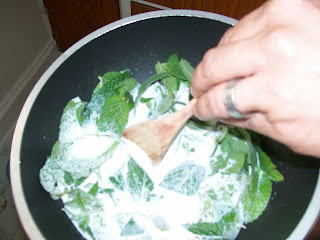
1. Put the mint leaves in a heavy saucepan with the 1 cup of milk and 1 cup of the cream. Heat until just steaming (do not let boil), remove from heat, cover, and let stand for 30 minutes. Reheat the mixture until steaming, remove from heat and let stand for 15 more minutes.

2. While the mint is infusing in step 1, prepare the remaining cream over an ice bath. Pour the remaining 1 cup of cream into a medium size metal bowl, set in ice water (with lots of ice) over a larger bowl. Set a mesh strainer on top of the bowls. Set aside.

3. Strain the milk cream mixture into a separate bowl, pressing against the mint leaves with a rubber spatula in the sieve to get the most liquid out of them. Return the milk cream mixture to the saucepan. Add sugar and salt to the mixture. Heat until just steaming again, stirring until sugar has dissolved. Remove from heat.

4. Whisk the egg yolks in a medium sized bowl. Slowly pour the heated milk cream mixture into the egg yolks, whisking constantly so that the egg yolks are tempered by the warm mixture, but not cooked by it. Scrape the warmed egg yolks back into the saucepan.
5. Return the saucepan to the stove, stirring the mixture constantly over medium heat with a wooden spoon, scraping the bottom as you stir, until the mixture thickens and coats the spoon so that you can run your finger across the coating and have the coating not run. This can take about 10 minutes.
If the custard base does not coat the back of the spoon, it is not ready. The custard base coats the back of the spoon. You can run your finger across the coating and have it not run. It is ready and should be removed from heat immediately, and poured through the sieve over the ice bath to stop the cooking.

6. Pour the custard through the strainer (from step 2) and stir into the cold cream to stop the cooking.


7. Chill the mixture thoroughly in the refrigerator (at least a couple of hours) or stir the mixture in the bowl placed over the ice bath until thoroughly chilled (20 minutes or so). Freeze the mixture in your ice cream maker according to the manufacturer's instructions.


8. Once the ice cream has been made in the ice cream maker it should be pretty soft. Gently fold in the finely chopped chocolate. Put in an airtight container and place in the freezer for at least an hour, preferably several hours. If it has been frozen for more than a day, you may need to let it sit at room temperature for a few minutes to soften it before serving.
Note that there is no alcohol in this recipe. A few teaspoons of some spirits such as rum or bourbon will help keep the ice cream soft over several days. Even the alcohol in vanilla extract will help. If you have no added alcohol in a homemade ice cream recipe, we recommend that you eat it up quickly, in a day or two; beyond that point the ice cream will quickly get very very hard.
Note that if you do not have fresh mint, you can make this mint chocolate chip ice cream recipe with peppermint extract. Skip steps 1 and 2, instead heating 1 cup of milk with 1 cup of cream and the sugar and salt until steaming. Continue with step 3. Add 2 teaspoons of peppermint extract in with the chilled custard mixture in step 6.


Subscribe to:
Posts (Atom)